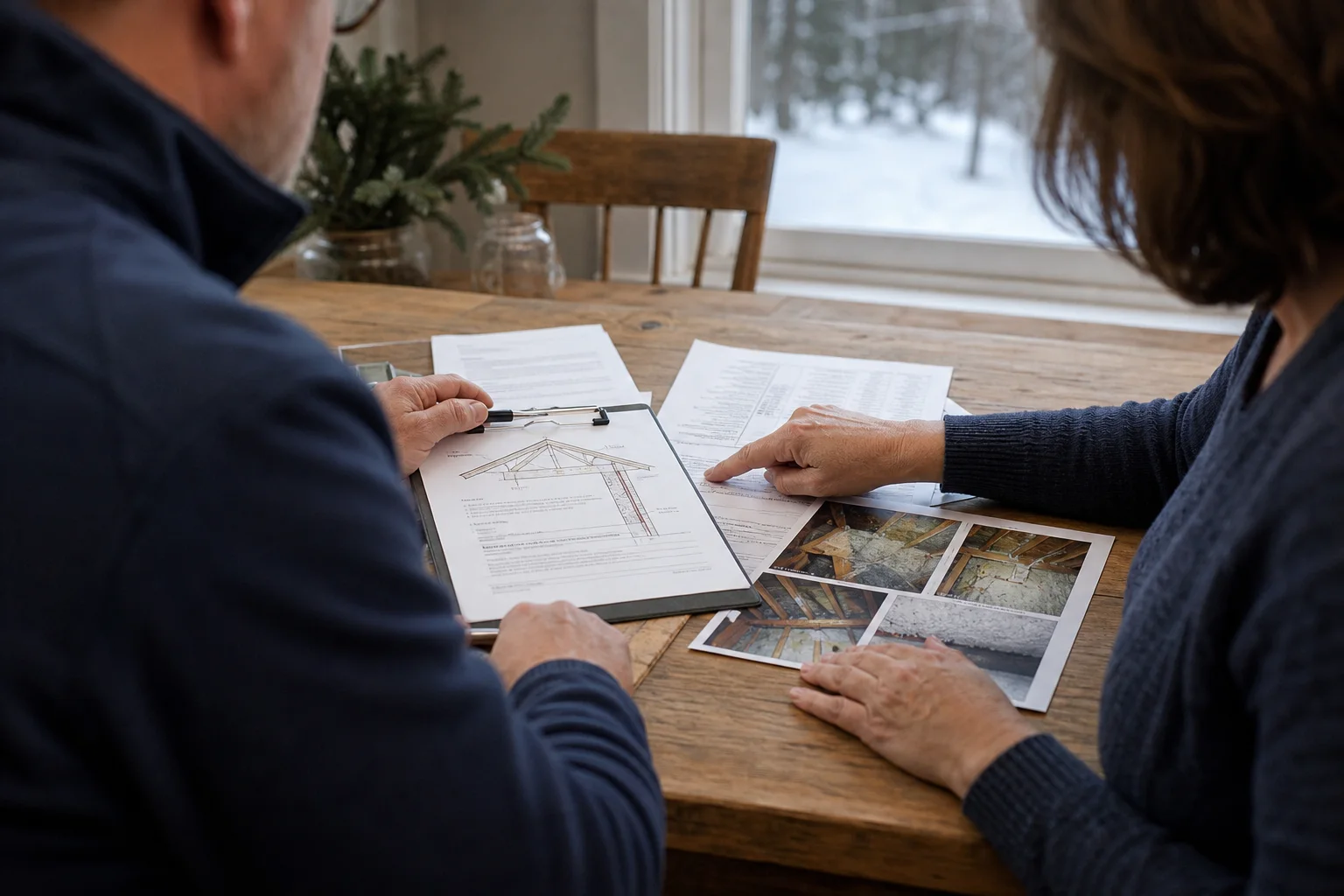
The six common reasons spray foam is removed
| Failure path | What may be observed | What must be investigated |
|---|---|---|
| Moisture behind foam | Staining, decay, elevated readings, roof damage | Roof leaks, indoor vapor, exhausts, foam thickness, substrate moisture |
| Off-ratio application | Persistent odor, soft or brittle material, unusual color or texture | Product records, equipment logs, installer and manufacturer guidance |
| Poor adhesion or pull-away | Gaps at framing, curled edges, detached sections | Surface temperature, dust, oil, moisture, lift thickness, cure |
| Incomplete coverage | Cold strips, drafts, visible voids, uneven depth | Boundary continuity, penetrations, thermal imaging, depth checks |
| Concealed inspection or repair | Framing, fasteners, wiring, or roof deck cannot be reached | Exact access needed and whether selective removal is sufficient |
| Wrong assembly | Condensation, trapped moisture, comfort problem persists | Air, water, vapor, and thermal-control strategy for the whole building part |
What most people miss
The visible foam can be where a symptom appears without being the original cause. A leaking roof, bath fan exhausting into an attic, high winter indoor humidity, foundation seepage, or inaccessible wiring can create the need for removal even when the foam itself cured normally. Diagnosis has to follow the water, air, heat, and access problem.
Moisture at a roof deck
In a cold-climate roof assembly, indoor water vapor can reach cold sheathing and condense. Risk rises when open-cell foam is vapor permeable, the application is too thin, gaps allow air movement, indoor humidity is high, exhaust fans terminate in the attic, or the wood was wet before spraying.
Building America guidance and the Building Science Corporation residential spray foam guide treat the roof as an assembly. In Binghamton's climate, the vapor-control layer, foam type, depth, indoor humidity, roof condition, and ventilation strategy have to work together.
Removal may be necessary when the roof sheathing is decayed, needs replacement, cannot dry, or must be exposed to locate the failure. If the problem is a small roof leak with otherwise dry and sound materials, a professional may recommend selective access instead. The inspection should decide the extent.
Off-ratio foam and persistent odor
Two-component professional spray foam depends on the A and B components being delivered at the correct ratio and under acceptable temperature and equipment conditions. A mixing or application failure can produce material that remains soft, brittle, friable, discolored, or persistently odorous.
Odor alone does not identify the chemical or prove the cause. Do not rely on a fragrance, sealant, or additional layer of foam to hide it. Gather the product name, safety data sheet, installation date, batch or lot information if available, photographs, temperature history, and written installer response. Contact the manufacturer and use qualified indoor-environment or remediation help when appropriate.
The EPA's spray polyurethane foam guidance emphasizes product-specific ventilation, cure, and re-entry instructions. It does not provide one universal time that makes every installation acceptable.
Pull-away, gaps, and failed adhesion
Foam may separate from framing or sheathing when the substrate is wet, dusty, oily, too cold, too hot, or otherwise outside product requirements. Excessive pass thickness and application timing can also matter. A small isolated gap and widespread detachment are not the same problem.
Document the pattern before repair:
- Photograph every visible gap with location context.
- Mark whether separation is at framing, sheathing, masonry, or metal.
- Measure approximate gap width and length.
- Note indoor and outdoor conditions when the symptom appears.
- Check for staining, corrosion, or moisture at the same location.
- Compare the installed surface with the product data sheet requirements.
If the substrate is sound and the failure is isolated, selective trimming and reapplication may be possible. If adhesion failed across the assembly, covering it with another pass can conceal the evidence without fixing the bond.
Foam that blocks inspection or future repairs
Spray foam adheres to the surface it covers. That continuity is useful for air control, but it also makes future access harder. Roof sheathing, rafters, fasteners, sill plates, wiring routes, and metal-panel connections may no longer be visible.
Removal for access is sometimes unavoidable when:
- A roof deck or framing member must be replaced
- Electrical or mechanical work cannot be safely reached
- A buyer's inspector needs to evaluate a documented concern
- Termite, rot, fire, or water damage must be traced
- A building alteration changes the assembly
Photographs before installation are the simplest way to reduce this uncertainty. They cannot replace future physical access, but they preserve the original condition and layout.
A practical investigation sequence
1. Stop altering the evidence
Do not cut, coat, deodorize, heat, or add foam before the condition is documented. Changes can spread dust, expose wiring, or make the original failure harder to identify.
2. Build the installation record
Collect the contract, product name, technical and safety data sheets, photographs, installer information, permit records, warranty, installation date, and previous complaints or repairs.
3. Map the symptom
Record exactly where odor, staining, gaps, cold spots, or moisture occur. Note whether the symptom changes with rain, temperature, humidity, heating-system operation, or closed windows.
4. Check the building source first
Investigate roof and plumbing leaks, exhaust terminations, foundation water, indoor humidity, drainage, and mechanical equipment. Foam is not a repair for bulk water.
5. Use targeted diagnostics
A qualified professional may use moisture measurements, thermal imaging, borescope access, material sampling, or selective removal. Each tool answers a different question and has limits.
6. Compare repair options in writing
Require the evaluator to identify the cause, affected area, removal extent, substrate repairs, cleaning, replacement assembly, protection, disposal, verification, and conditions for reoccupancy.
Repair, partial removal, or full removal
| Finding | Possible response | Important caution |
|---|---|---|
| Isolated void with dry, sound substrate | Local trimming and compatible repair | Confirm why the void occurred first |
| Small access area needed | Selective removal | Protect wiring, finishes, and occupants from dust |
| Active roof or plumbing leak | Repair water source, expose affected area, dry and assess | Do not seal wet material back in |
| Widespread off-ratio material | Manufacturer-supported remediation, often extensive removal | Adding coatings may not solve the source |
| Decayed roof sheathing | Remove enough foam for structural repair | Replacement assembly must address moisture path |
| No defect, only missing records | Document current condition and monitor | Removal may create more damage than useful evidence |
There is no responsible universal rule for how many square feet must come out. The failure boundary and repair access determine the scope.
Why removal is expensive
Foam is designed to adhere and fill irregular spaces. Removing it reverses those benefits. Labor may include hand cutting and scraping, containment, dust control, disposal, work around wiring or fasteners, substrate repair, and replacement insulation. Roof or wall finishes may also have to be opened.
Ask removal contractors to separate:
- Investigation and test openings
- Containment and occupant protection
- Foam removal area and depth
- Disposal
- Framing, sheathing, wiring, or finish repairs
- Cleaning and verification
- Replacement assembly
- Temporary weather protection or building downtime
How to reduce the chance of removal before installation
- Fix roof, plumbing, drainage, and foundation water first.
- Measure and record wood moisture before spraying.
- Select a product for the assembly, not from price alone.
- Keep the technical data sheet and safety data sheet.
- Define depth, vapor control, clearances, and protective covering.
- Use the manufacturer's application, ventilation, cure, and re-entry protocol.
- Photograph every concealed surface before and after spraying.
- Verify coverage before finishes hide the work.
- Keep electrical and mechanical service points accessible.
- Put the warranty and remediation process in writing.
Frequently asked removal questions
Does all spray foam eventually need to be removed?
No. Removal is tied to failure, access, repair, or uncertainty in a specific installation. Correctly performing foam is not removed on a schedule.
Can failed foam be sprayed over?
Not until the cause is known. New foam does not correct wet material, poor adhesion, off-ratio chemistry, unsafe clearances, or an incorrect assembly.
Is persistent odor proof of off-ratio foam?
No. It is a symptom that deserves documentation and professional evaluation. Product, installation, ventilation, moisture, and other indoor sources may need to be considered.
Can thermal imaging prove foam is installed correctly?
Thermal imaging can reveal temperature patterns consistent with gaps or missing coverage under suitable conditions. It does not identify chemistry, adhesion, concealed rot, or every moisture condition.
Can I remove spray foam myself?
Large or uncertain removal can disturb dust, wiring, damaged materials, and chemical residues. Obtain a product-specific and condition-specific plan before cutting.
Will homeowners insurance pay for removal?
Coverage depends on the policy, cause, exclusions, evidence, and insurer decision. Ask the insurer about the specific loss and do not assume insulation removal is covered.
Sources and boundaries
- Building Science Corporation: Residential spray foam guide
- Building America Solution Center: Unvented attic assemblies
- EPA: Quick safety tips for spray polyurethane foam users
- EPA: Ventilation guidance for spray polyurethane foam
This guide does not diagnose an installation or provide medical, legal, insurance, or indoor-air-quality advice.
Start with evidence, not demolition
Share the product records, photographs, location, visible symptoms, and moisture history. The first useful scope identifies what must be inspected and why before anyone prices removal or replacement.